Theory
A metalworking fluid cools and lubricates, but not equally well everywhere. How far it reaches the hottest point of the cutting process is not a property of the fluid but a question of process and delivery method: under free flood delivery from outside that region stays largely closed to it, under through-tool and high-pressure delivery it does not. What a fluid actually achieves is decided at three separate friction sites, in the additive chemistry, and in one ingredient that appears in no formulation: the make-up water.
Three friction sites and how well they can be reached
Cutting produces three friction sites that have to be kept apart, because a fluid reaches them differently. In the shear zone the material is plastically deformed; this is where most of the heat is generated. At the rake face the outgoing chip presses down under high pressure. At the flank face the recovering workpiece surface rubs; this is where lubrication acts most directly on flank wear and surface finish.
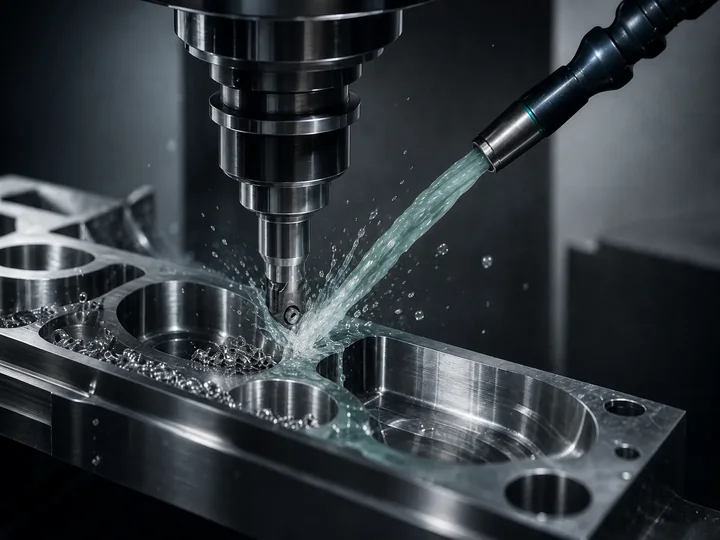
How far a fluid penetrates these zones is not a property of the fluid but a question of process and delivery method. Under free flood delivery from outside, the immediate contact between chip and rake face is only partly accessible; liquid reaches it mainly by capillary action and in fractions of a second. Through-tool coolant delivery, high-pressure delivery and many grinding processes change that picture substantially: they can reach the tool, the workpiece and the rake face region in a targeted way, break the chip and remove heat directly. Denying accessibility in general terms wrongly implies that nothing can be improved at the delivery side.
The question is not whether a metalworking fluid reaches the hot zone, but by what means. Under flood delivery it acts mainly through chip, workpiece and machine and through the friction it removes; with through-tool or high-pressure delivery, reaching the cutting point itself becomes a control variable.
Full-film lubrication does not occur here
The German IFA practical guidance distinguishes two operating states. Under full-film lubrication a continuous lubricating film forms between the sliding partners and wear falls sharply. Whether that film forms at all, and how much it carries, is not governed by viscosity alone: viscosity is one influencing variable within the hydrodynamic or elastohydrodynamic system, alongside sliding speed, load, contact geometry, surface roughness and temperature. Under partial or boundary lubrication there is partial solid-to-solid contact; wear can then no longer be prevented, only limited to an economically acceptable level. In machining with water-mix fluids the second state prevails almost without exception. The water fraction carries no load. What carries load is the dispersed oil and the additive chemistry.
AW and EP additives: boundary layers, not a lubricating film
Anti-wear (AW) and extreme-pressure (EP) additives act through boundary layers on the metal surface. These layers form in two ways that run alongside one another in practice: by physical adsorption of surface-active molecules, and as tribochemically formed reaction layers on the freshly generated, highly reactive metal surface produced in the cut. The IFA names sulphates, chlorides and phosphates among the reaction products. Both mechanisms reduce direct metal-to-metal contact and therefore wear and frictional heat. But they do not replace a load-bearing lubricating film; they limit the damage where no load-bearing film can form.
What matters for selection: how effective such a boundary layer is depends on the interplay of additive chemistry, contact pressure, temperature and surface condition, not on a single switching threshold. Adsorptive additives contribute at moderate conditions; more strongly reactive systems typically develop their effect under higher loads. A heavily reactive formulation in a lightly loaded process therefore often delivers less than its price suggests. Which combination works has to be established on the process, not deduced from a data sheet.
Two side effects belong in the picture. Sulphur carriers are not harmless: the IFA points out explicitly that sulphur-bearing additives contain potent sensitisers and are strongly odorous. And chlorinated additives are being phased out: the IFA advises against them because they are persistent, generate hazardous pyrolysis products at insufficient combustion temperatures, and turn used metalworking fluid into hazardous waste. Tricresyl phosphate and zinc dialkyldithiophosphate are likewise no longer recommended.
Cooling and lubricating pull in opposite directions
The cooling effect of a fluid depends on specific heat capacity, thermal conductivity and heat of vaporisation. The orders of magnitude for water and mineral oil are far enough apart to establish a fixed ranking.
| Property | Water | Mineral oil |
|---|---|---|
| Specific heat capacity | approx. 4.2 J/(g·K) | approx. 1.9 J/(g·K) |
| Thermal conductivity | approx. 0.6 W/(m·K) | approx. 0.1 W/(m·K) |
| Heat of vaporisation (40 °C) | approx. 2,300 J/g | approx. 200 J/g |
Solutions cool better than emulsions, and emulsions better than neat cutting oils; with oils, cooling capacity also falls as viscosity rises. Lubricating performance is graded the other way round. Choosing between an emulsion and a neat cutting oil is therefore not a matter of preference but the question of whether heat or friction is the limiting problem in the specific process.
Emulsion, solution, microemulsion
By the IFA definition, an emulsion is a cloudy, milky liquid made of two normally immiscible liquids. In machining this is almost always the oil-in-water type: oil droplets in an aqueous continuous phase, stabilised by emulsifiers. What is decisive, and rarely present in day-to-day operation: the IFA characterises emulsions expressly as unstable systems with a limited life. An emulsion is a state you actively maintain, not a substance you purchase. A solution, by contrast, is homogeneous to the naked eye; its cooling capacity is higher and its lubricating effect lower unless lubricating components are dissolved in it.
The visual difference has a physical cause: turbidity arises from scattering of visible light by the oil droplets. Classical emulsion droplets lie in the micrometre range and therefore scatter; microemulsion droplets typically lie between roughly 10 and 200 nanometres, fall below the wavelength of visible light and appear clear to slightly opalescent. The shop-floor rule of thumb (milky means more lubrication, clear means more cooling) captures the tendency, but appearance is not a measurement; it is an indication of the formulation class.
Mineral-oil-free, fully synthetic systems behave systematically differently in terms of cleanliness, filtration and service life. They are the subject of our knowledge page on fully synthetic metalworking fluids and are not duplicated here.
Water is not a bit player
At 5 per cent working concentration the sump is 95 per cent make-up water. Its composition is therefore part of the formulation, not a boundary condition. The IFA requires drinking-water quality, free of particles and germs, with no more than 100 colony-forming units per millilitre and no pathogenic organisms; 10 to 20 degrees of German hardness (roughly 1.8 to 3.6 mmol/l of alkaline earth ions) is given as the favourable range. Water that is too soft promotes foaming; water that is too hard promotes lime soaps and residues on parts. Nitrate content must not exceed 50 mg/l; that is a requirement from TRGS 611, because nitrate is the precursor of nitrite.
For topping up (not for the initial charge) the IFA recommends de-ionised water from an ion exchanger or reverse osmosis. When water evaporates from the sump the salts remain; topping up with salt-bearing water concentrates that load further with every addition. This is why a sump behaves differently after some months even though nothing else was ever added: it is not the concentrate that has changed, but the electrolyte content of the water.
Sources: IFA practical guidance on metalworking fluids (Institut für Arbeitsschutz der Deutschen Gesetzlichen Unfallversicherung), glossary entries on cooling effect, lubricating effect, extreme-pressure additives, emulsion, solution and make-up water (accessed 09.08.2026). Nitrate in make-up water: TRGS 611 (May 2007 edition), number 5.2 paragraph 1, a German Technical Rule for Hazardous Substances. Droplet sizes and light scattering: general colloid chemistry (see the sources list, entry “Colloid chemistry”). That is not a metalworking-fluid-specific standard. The description of boundary-layer formation by AW and EP additives is deliberately kept neutral against the widespread short version: adsorption and tribochemical reaction run alongside one another, and there is no single activation temperature.
↑ Back to contentsIn practice
On the shop floor, four things govern how a sump behaves: how it was mixed, what concentration it runs at, how warm it gets, and which material runs through it. Three of those are measurable, the fourth is on the works order. All four are managed less closely than the tooling they are meant to protect.
Working concentration: the most underrated control variable
The IFA gives 4 to 8 per cent as the typical range, depending on the manufacturer's specification. The actual target value is in the technical data sheet of the individual product and nowhere else. Measurement is usually by hand refractometer, following a rule that is simple and still applied incorrectly on a regular basis: scale reading multiplied by the product-specific refractive factor gives the working concentration. That factor is a product property and is not transferable. Anyone who keeps using the old factor after changing product will be systematically off target without the measurement showing it.
Refractometry has two well-known interferences: large quantities of emulsified tramp oil refract light as well and simulate too high a concentration, and unstable emulsions with large droplets blur the reading line. Both occur precisely when the sump is already in trouble. That is why the refractometer alone is not sufficient: it reports flattering values exactly in the critical phase. Contaminated media should be filtered beforehand; where the line is hard to read, dilute and double the scale value.
Acid split titration is the complementary method, not the independent one. It also needs a product-specific factor and is insensitive to the tramp oil content that disturbs refractometry; it is distorted instead by the carry-in of larger quantities of acids, alkalis or biocides. That is exactly why the two methods complement each other.
What they do not do is validate one another. Both share the same error sources. Non-representative sampling, water loss through evaporation and a composition that has shifted over the sump's life distort both measurements in the same direction. And without product-specific calibration, titration strictly speaking measures alkalinity or alkaline reserve rather than concentration, a quantity related to concentration but not identical with it. Two readings that agree are therefore no proof of a correct reading. Where the two results diverge strongly, DGUV Rule 109-003 recommends determination by a laboratory method; even where they agree, the laboratory method remains the benchmark against which the in-house factors have to be calibrated.
Mixing: concentrate into water, not the other way round
The initial charge determines the droplet size distribution and with it the stability of the sump for its entire life. Concentrate goes into water, not water into concentrate. Otherwise a water-in-oil phase forms first and leaves coarse, unstable droplets behind when it inverts. Proportioning or venturi mixers produce a reproducible distribution; hand-mixed charges scatter. The IFA lists correct mixing expressly as a maintenance measure, not as preparation.
Temperature control: where a lubricant becomes a metrology problem
For machining operations the IFA practical guidance gives a typical application-related limit temperature of 40 °C; above it, temperature is to be monitored regularly. Beyond that mark several effects run unfavourably at once: evaporation rises and with it the concentration, microbial growth accelerates, and the thermal expansion of workpiece and machine migrates into dimensional accuracy.
This is the point where the metalworking fluid stops being a lubricant topic and becomes a production metrology topic. Metals expand when heated: workpiece, tool, clamping and machine structure simultaneously and to differing degrees. A sump that warms up over the shift therefore shifts dimensions; this shows up first on long parts and tight tolerance bands. We deliberately give no worked example here: the magnitude depends on material, part length, temperature rise, clamping concept and measuring strategy, and an example calculation without those inputs is regularly reused on the shop floor as a rule of thumb. If you want to quantify the effect, do it with the expansion coefficient of your actual material from a materials reference and with the temperature rise measured on your own sump. The reliable statement of this section is a different one: a sump without temperature control is an uncontrolled variable in the dimensional chain.
Material and tooling
With unalloyed and low-alloy steel and with cast iron, corrosion protection is the critical parameter. Too low a concentration shows up first as flash rust on chips and machine table, not on the part. Anyone who only inspects parts notices it too late. With aluminium and its alloys, strongly alkaline mixes attack the surface; silicon-bearing alloys are abrasive and load the filtration. With non-ferrous metals, dissolved copper ions cause discoloration and can impair emulsion stability, which is why products for non-ferrous work contain copper ion inhibitors.
One special case is little known outside the hazardous-substances literature and concerns ductile (spheroidal graphite) cast iron and certain magnesium alloys. DGUV Rule 109-003 (April 2026) names phosphine in section 5.1.2 as a possible toxic compound: it forms from chips or dust through the reaction of contained phosphorus, magnesium and water when machining ductile cast iron or certain magnesium alloys. Accumulations of chips and dust in containers in contact with water are the critical situation; the recognition feature is a garlic-like smell. The consequence is mundane and still neglected: remove such containers from the work area regularly and in good time. With magnesium, hydrogen formation is a further topic in its own right. These combinations belong in a risk assessment, not in a rule of thumb.
When a metalworking fluid does harm
In interrupted cutting the edge alternates cyclically between cut and air. Coolant lowers the edge temperature but at the same time increases the amplitude of the temperature swing and therefore the thermal shock; with susceptible cutting materials this raises the risk of comb cracking. That is why some milling operations are deliberately run dry, or with a constant and generous supply, rather than with intermittent cooling. What counts here is consistency, not quantity.
More metalworking fluid is not a comparative form of correctly set metalworking fluid. There are operations in which consistent delivery is worth more than generous delivery, and operations in which dry is the better choice.
Sources: IFA practical guidance, entries on working concentration and fluid maintenance, and the protective measure “Prüfung wassergemischter Kühlschmierstoffe” (limit temperature of 40 °C). Refractometry and titration compared, including the laboratory method where results diverge: DGUV Rule 109-003 (April 2026 edition), section 7.1.1. Phosphine: same rule, section 5.1.2. On thermal drift we deliberately give no example calculation, because the underlying material property could not be traced to a reference work in our review. Thermal shock and comb cracking rest on a trade publication (see sources list, entry “Comb cracking”) and are not codified normatively in the rules we checked.
↑ Back to contentsWhat it is worth
The economically interesting point is not the price per litre of concentrate. What a metalworking fluid costs arises across its whole life cycle. Most of it is booked somewhere other than purchasing.
Where the fluid sits in the costing
Alongside buying the concentrate, fluid-related costs include treatment of the make-up water, sump maintenance, monitoring with its labour content, filtration and tramp oil separation, system cleaning at changeover, disposal of the used emulsion, extraction and capture equipment, and the downtime an unplanned sump change creates. Only the first of those appears on the concentrate invoice.
We deliberately give no percentage here. Share-of-cost figures from studies in the automotive and high-volume sector are in circulation; we were unable to trace them to their primary source in the time available and therefore do not publish them. They would in any case be of limited transferability: in one-off production with expensive materials the balance shifts towards material and tooling costs. If you want the figure for your own operation, add up the items listed above for one machine over one year. That calculation takes an afternoon, and it is more reliable than any quoted ratio.
The statement that holds without a percentage: in many plants the metalworking fluid is bought on price per litre and maintained on instinct, while the tooling, which often costs less, is tool-life monitored and documented.
The four levers that actually pay
Tool life. It is measurable via flank wear width. ISO 3685 gives, as the tool-life criterion in turning, a mean flank wear width of 0.3 mm or a maximum of 0.6 mm, and a crater depth of 0.15 mm. A reproducible tool-life measurement is the only way to assess a fluid change at all. Without it, any statement about better tool life is an opinion.
Sump life. Every unplanned sump change avoided saves disposal cost, system cleaning and re-mixing. The largest item is usually machine downtime.
Scrap and rework. Residues, discoloration on non-ferrous parts, corrosion in intermediate storage and thermal dimensional deviation generate costs that production controlling rarely attributes to the metalworking fluid, even though that is where they originate.
Lost time through skin disease. Hand dermatoses are a well-established occupational disease pattern in metalworking. A trained machine operator absent because of cumulative irritant eczema costs more than any drum of concentrate. And that absence follows an exposure that can be measured and limited.
What cannot honestly be promised
A doubling of tool life from a fluid change alone is possible but not predictable; it depends on the starting condition. Coming from a badly set process you will see large jumps; coming from a well-maintained sump you will see a few per cent. For the same reason we quote no savings percentages without stating the specific starting condition. We also deliberately give no sump life in weeks or months: it ranges from a few weeks to several years depending on system size, tramp oil ingress, maintenance and the machining task. A figure without those conditions would mislead.
Sources: tool-life criteria to ISO 3685:1993. Cost items derived from the maintenance, monitoring and disposal requirements of DGUV Rule 109-003 (April 2026) and VDI 3397 Parts 2 and 3. Deliberately without a figure: the share-of-manufacturing-cost values circulating in the market could not be verified to primary source and are therefore not published here.
Review my application
Does the same arithmetic apply to you?
Which of the cost items above matters in your plant depends on batch size, material, equipment and the current state of maintenance. We look at the process before we name a product.
Risks
A water-mix sump is a colonised habitat, a chemical reactor and an emission source in one. The four risks that matter are connected: micro-organisms lower the pH, a falling pH promotes nitrosamine formation, tramp oil cuts off oxygen input and accelerates both, and all of it ends up as aerosol in the workshop air and on the operators' skin.
Microbiology: the sump is alive
Water-mix metalworking fluids are colonised by a mixed flora of various bacterial species and/or fungi and yeasts. Counts reach orders of magnitude of 10⁶ to 10⁸ colony-forming units per millilitre. For comparison, the make-up water contributes of the order of 10² organisms per millilitre; the rest grows in the sump. The consequences the IFA names are a putrid smell, emulsion breakdown and foaming, a falling pH and rising nitrite content, corrosion, respiratory exposure of employees to moulds and bacteria, and infection of contaminated wounds.
The notorious Monday smell is no coincidence. When circulation stops, oxygen input ceases and anaerobic metabolic pathways (including sulphate reduction to hydrogen sulphide) take over. Weekend aeration is therefore an effective and cheap measure.
Nitrite and nitrosamines: the common short version is incomplete
Nitrite can be formed microbially from nitrate, and nitrite reacts with secondary amines, which occur in corrosion inhibitors and pH regulators, to form N-nitrosamines, several of which are classified as carcinogenic. This is precisely why TRGS 611 intervenes at two points: the nitrate load of the make-up water, and the nitrite content of the sump.
The usual formulation is that water-mix metalworking fluids must not contain more than 20 mg/l of nitrite. That statement is not wrong; DGUV Rule 109-003 (April 2026) puts it that way in section 7.1.1. But it is incomplete. The rules work with four thresholds that trigger different consequences. If you only know the 20, you either measure too rarely or escalate too late.
| Nitrite content in the used fluid | Consequence | Reference |
|---|---|---|
| General rule | Measure nitrite content weekly | TRGS 611 no. 5.3 para. 2 |
| Three consecutive readings below 10 mg/l | Measuring interval may be extended to at most four weeks | TRGS 611 no. 5.3 para. 2 |
| Above 10 mg/l | Return to the weekly measuring interval | TRGS 611 no. 5.3 para. 3 |
| Above 20 mg/l | Find and eliminate the nitrite source; add an inhibited fluid or an inhibitor; where appropriate carry out a partial or full change, in consultation with the manufacturer | TRGS 611 no. 5.3 para. 3 and no. 5.4 para. 2; DGUV Rule 109-003 Annex 3a |
| Above 80 mg/l | Verify inhibitor effectiveness for the individual case; determine NDELA in the fluid and in the air | DGUV Rule 109-003 Annex 3a |
| Above 5 mg/kg NDELA in the fluid | Change the fluid, clean the circuit, eliminate the nitrite source; document all measures | TRGS 611 no. 5.4; DGUV Rule 109-003 Annex 3a |
The 20 mg/l figure is therefore an action threshold at which intervention becomes mandatory. It is not a maximum content below which everything is fine. The 10 mg/l figure is not a health threshold but the condition governing whether you may measure less often. And above 80 mg/l the nitrite measurement no longer suffices: the reaction product itself, N-nitrosodiethanolamine, has to be determined. Annex 3a notes that a water-mix fluid with sufficient inhibitor can, according to practical experience, be used safely in the range between 20 and 80 mg/l. That is a statement about inhibited systems and belongs with the manufacturer, not in a rule of thumb.
TRGS 611 also limits the cause rather than only the effect: secondary amines are not permitted as a constituent of the concentrate, and their content arising from impurities and secondary constituents must not exceed 0.2 per cent by mass of the concentrate. For day-to-day operation, the connection most often overlooked remains: a falling pH promotes nitrosamine formation. pH control is therefore not only corrosion protection but directly a health protection measure.
Skin
The IFA distinguishes two routes to contact eczema. The non-allergic, irritant route arises acutely from a single strong exposure but above all cumulatively, through repeated and individually harmless exposure to water, alkalis and surfactants; employees with naturally dry skin are particularly affected. The allergic route is a delayed-type reaction that becomes visible only after one to several days and presupposes prior sensitisation.
What matters for prevention is how the two routes are connected, and how they are not. An irritant eczema does not turn into an allergic one: damage to the skin barrier is not an immunological process, whereas sensitisation to a particular ingredient is. They remain two separate disease mechanisms. The connection between them lies elsewhere, and it is the reason why mundane continuous exposure is not a secondary concern: a skin barrier that is already damaged lets substances penetrate more easily and therefore raises the risk that sensitisation occurs at all. Reducing the cumulative irritant load therefore also reduces the risk of sensitisation. Water-mix fluids are more demanding here than neat cutting oils, because the aqueous phase degreases and the pH lies in the alkaline range. Activities involving skin contact with water-mix metalworking fluids are to be assessed at the workplace under TRGS 401 (October 2022 edition), from which a skin protection plan, glove selection and instruction follow.
A formulation can avoid individual known triggers, for example by being free of boron, amines or formaldehyde releasers. That does not remove the skin hazard at the workplace: it arises from concentration, sump age, microbial load, tramp oil ingress and contact time, and has to be assessed in the plant under TRGS 401.
Aerosols and mist: there is no occupational exposure limit
Metalworking fluid mist forms through atomisation at rotating parts and through evaporation followed by condensation. Here is the finding most often misremembered in practice: to this day there is no occupational-medically and toxicologically justified occupational exposure limit for metalworking fluids as a whole substance. The much-quoted 10 mg/m³ appeared in the 2000 version of TRGS 900 and ceased to be an occupational exposure limit when that rule was reissued as “Arbeitsplatzgrenzwerte” (Occupational Exposure Limits) in January 2006. Anyone quoting it today as an exposure limit is quoting a value that has not existed for twenty years.
Assessment is instead multi-stage, and the stages must be kept strictly apart.
First, substance-related occupational exposure limits. The binding assessment benchmarks under TRGS 402 (September 2023 edition) are occupational exposure limits under TRGS 900, acceptance and tolerance concentrations for carcinogens under TRGS 910, benchmarks from substance-specific Technical Rules, and binding EU limit values. An occupational exposure limit always applies to the named substance, never to a product. The entry most often cited in this context is “mineral oils (petroleum), highly refined” at 5 mg/m³, to be assessed as the sum of vapour and aerosols (TRGS 900 in the version of 05.06.2026). This is not a summation limit for metalworking fluids. It is relevant in so far as those highly refined mineral oils actually form part of the exposure, and it cannot be transferred to mineral-oil-free systems. Which substances have to be considered in a given case follows from the safety data sheet and the risk assessment, not from the product category.
Second, the component-related assessment. Individual ingredients have their own occupational exposure limits, among them 0.5 mg/m³ for boric acid and sodium borates calculated as boron. That is the technical background to boron-free formulations having a role in the market; that is a statement about the rules, not a product advantage. The exposure limits of the metals being machined apply in addition.
Third, and separate from these, the exposure limitation value. For water-mix metalworking fluids in metalworking, DGUV Rule 109-003 gives an exposure limitation value of 8 mg/m³ in its April 2026 edition. The rule is unusually candid about its status: exposure limitation values are not health-based limit values, and health risks to employees cannot be excluded even where they are observed. The value reflects the state of the art, not a threshold of harmlessness. It does not replace the substance-related assessment but sits alongside it.
So anyone who quotes “the limit for metalworking fluid mist” compresses a three-stage system into one number. And anyone treating the 5 mg/m³ and the 8 mg/m³ as two versions of the same value is conflating a substance-related legal limit with a technically derived benchmark.
Contaminants: why tramp oil is the main offender
The IFA groups as contaminants the unintended carry-ins into the fluid: solid particles from chips and tool wear, tramp oils above all from leaks in hydraulic and total-loss lubrication systems, plus corrosion protection oils, quenching oils and solvent residues; expressly named, finally, are food waste, drink residues and sweepings. The consequence is a substantial change in fluid properties and a marked reduction in service life; coarse contamination such as cleaning rags can block pipework and pumps.
Tramp oil is the underrated main offender because it acts in four ways at once: it forms a film on the sump surface and cuts off oxygen input, which favours anaerobic organisms; it distorts the refractometer reading; it depletes emulsifiers; and it increases oil mist formation. A sump with a high tramp oil content goes off faster, regardless of how good the concentrate is.
Foam, corrosion, fire, disposal
Foam is promoted by make-up water that is too soft, by high circulation rates and by air ingress at leaks; it degrades cooling at the cutting point and can cause systems to overflow. Corrosion occurs on the part as much as on the machine; typical triggers are too low a working concentration or a falling pH. Fire is secondary with water-mix fluids in normal operation, but is a real subject for the risk assessment where residues are strongly concentrated, where oil mist accumulates in extraction systems, and when machining reactive materials such as magnesium or fine titanium chips. Disposal of used emulsion is a separate, documented operation under waste law; chlorine-bearing additives make used metalworking fluid hazardous waste according to the IFA.
Sources: bacterial counts, contaminants, contact eczema and foam: IFA practical guidance on metalworking fluids, glossary entries on micro-organisms, contaminants, contact eczema and pH (accessed 09.08.2026). Nitrite stages: TRGS 611 (May 2007) nos. 5.2 to 5.4 and DGUV Rule 109-003 (April 2026), Annex 3a. Secondary amines at 0.2 per cent by mass: TRGS 611 no. 4.2. Skin hazard: TRGS 401 (October 2022, last amended GMBl 2024 p. 769). Limit-value system: TRGS 402 (September 2023), TRGS 900 (version of 05.06.2026, entry “mineral oils (petroleum), highly refined”, 5 mg/m³, sum of vapour and aerosols), DGUV Rule 109-003 (April 2026) section 5.1.2.1 and Table 1. All of these are German rules; readers outside Germany should compare them with the equivalent national provisions. We deliberately keep the two routes to contact eczema apart: a damaged skin barrier raises the risk of sensitisation, but an irritant eczema does not turn into an allergic one. The widespread shorthand about a “progression” misstates the relationship.
↑ Back to contentsMonitoring and test plan
Under TRGS 611 the employer is obliged to check nitrite content and pH regularly and to document the results; documentation is to take the form of a test plan. DGUV Rule 109-003 (April 2026 edition) gives this concrete shape in section 7.1.1 with a model test plan (Annex 3a) and a model form (Annex 3b). For a target-versus-actual comparison the plan must contain at least the nitrite content of the water-mix fluid, the pH, the nitrate and nitrite content of the make-up water, the working concentration and any perceptible changes. Further parameters should be carried for application-technical reasons.
Both documents are German rules. Where you operate outside Germany they are not directly binding, but the plan below is a defensible state-of-the-art baseline, and the underlying failure mechanisms are the same everywhere.
| Parameter | Method | Interval | Criterion / action threshold | Reference |
|---|---|---|---|---|
| Perceptible changes (appearance, smell) | Visual and olfactory check | daily | no conspicuous deviation from the fresh charge | DGUV Rule 109-003, Annex 3a |
| pH | Laboratory: electrometric with a pH meter. On site: pH paper with special indicators in a suitable measuring range, no universal indicators | weekly; monthly when machining glass and ceramics | drop of more than 0.5 points against the initial charge: measures per manufacturer's recommendation. More than 1.0 points: consider changing the fluid and cleaning the circuit | TRGS 611 no. 5.9; DGUV Rule 109-003, Annex 3a |
| Working concentration | Hand refractometer: scale reading × product-specific refractive factor | weekly, plus at every new charge | manufacturer's target value | DGUV Rule 109-003, Annex 3a |
| Alkaline reserve | Acid titration per manufacturer's recommendation | as required | product-specific | DGUV Rule 109-003, Annex 3a |
| Nitrite content | Test strips or laboratory method | weekly; after three consecutive readings below 10 mg/l, extension to at most four weeks is permitted; one reading above 10 mg/l means a return to weekly | above 20 mg/l: eliminate the nitrite source, add an inhibited fluid or inhibitor, partial change where appropriate. Above 80 mg/l: verify inhibitor effectiveness, determine NDELA in fluid and air. Above 5 mg/kg NDELA: change out and clean the circuit | TRGS 611 nos. 5.3 and 5.4; DGUV Rule 109-003, Annex 3a |
| Nitrate and nitrite content of the make-up water | Test strips or laboratory method (generally not required for mains supply) | as required | nitrate no more than 50 mg/l; if exceeded on a mains supply, notify the water utility | TRGS 611 no. 5.2; DGUV Rule 109-003, Annex 3a |
| Hardness and origin of the make-up water | Titration or information from the utility | at every new charge and on change of water source | 10 to 20 degrees of German hardness is favourable; drinking-water quality, no more than 10² colony-forming units per millilitre, no pathogens | DGUV Rule 109-003, section 7.1.1; IFA practical guidance |
| Sump temperature | Thermometer or plant sensors | regularly once the limit temperature is exceeded | typical application-related limit of 40 °C in machining | IFA practical guidance, testing of water-mix fluids |
| Tramp oil content | Visual check; document separator performance | regularly, to be set by the plant | no closed oil film on the sump surface | VDI 3397 Part 2 (June 2014) |
| Microbial load (trend monitoring) | Dip slides with non-selective standard culture media for total colony count | to be set by the plant; there is no monitoring obligation | no guide value. The trend is what is assessed. Dip slides are semi-quantitative and most reliable between 10³ and 10⁴ CFU/ml | DGUV Rule 109-003, section 7.1.1; DGUV Information 209-051 (July 2016) |
Documentation, competence, sampling
Documentation duty. Test results are to be documented. Any biocide addition is to be documented separately: type of biocide, concentration over the period of use taking necessary top-ups into account, and the maximum concentration specified by the biocide manufacturer, which must not be exceeded. An addition should only be made after consulting the supplier.
Competence requirement. Testing must be carried out by competent persons. Competence may rest with the management itself, with employees or with external parties; it need not be combined in one person, and the knowledge is to be kept current.
Sampling. The rule is precise here and practice rarely is: the sample should be taken while the fluid is circulating, from the clean tank or directly from the supply line. A dip sample from a standing tank measures the stratification, not the sump.
Header data on the form. Annex 3b additionally provides for recording machine designation and number, fill volume, type of machining, the fluid, target concentration, refractive factor, titration factor, responsible persons, and for the make-up water its nitrate, nitrite, hardness and origin. These header data are what is missing most often in practice. Without the refractive factor, every concentration reading on the form is worthless.
Scope of the intervals. The intervals given apply to continuous operation. Other operating conditions can lead to other intervals, and exemptions under TRGS 611 are possible. A sump restarting after a long shutdown is not a case for the weekly rhythm.
Top up, partial change, full change or system clean?
This is the question most maintenance engineers arrive with, and the test plan alone does not answer it: it says what to measure, not which of the four measures a given reading triggers. The following allocation separates them. Where the rules give a figure, it is stated; where they do not, a decision criterion stands in place of an invented threshold.
| Measure | How to recognise the case | How to recognise that the measure is no longer enough |
|---|---|---|
| Topping up: water or concentrate | Working concentration is outside the manufacturer's target value, but pH and nitrite are within band, there are no perceptible changes, and the deviation is explained by a known cause: evaporation (concentration rises) or drag-out with parts and chips (concentration falls). Top up with de-ionised water; strengthen with pre-mixed emulsion. | The same correction is needed at ever shorter intervals, or refractometer and titration diverge increasingly. Then it is not drift but consumption or tramp oil ingress; the cause is not in the dosing. |
| Partial change or inhibitor addition | Nitrite exceeds 20 mg/l, or the pH has fallen by more than 0.5 points against the fresh charge on a sustained basis, or several infestation indicators rise together (falling alkaline reserve, foam, smell, creaming). The precondition is that the nitrite source can be identified and eliminated. TRGS 611 requires consultation with the manufacturer. | Nitrite rises again after the measure, the pH does not stabilise, or a second partial change becomes necessary within a short period. Above 80 mg/l nitrite, inhibitor effectiveness must additionally be verified for the individual case and NDELA determined in the fluid and in the air. |
| Full sump change | Mandatory above 5 mg/kg NDELA in the fluid. Also on a pH drop of more than 1.0 points, on a broken emulsion, on nitrite above 80 mg/l without demonstrated inhibitor effectiveness, and whenever topping up and partial change no longer bring the sump back within band. | The new charge does not reach the values of a fresh mix, or leaves them faster than its predecessor did. In that case the change was the right measure applied to the wrong object: the defect is in the equipment. |
| System cleaning | Always as part of a full sump change; a change without cleaning inoculates the new charge immediately. Additionally on visible biofilm on tank walls, floating biomass, blocked pipework, filters or pumps, and whenever a freshly mixed sump goes off faster than its predecessor. | The same findings recur after cleaning. Then check the parts of the system the circulation does not reach: dead legs, chip conveyors, return channels, and leaking hydraulics as a permanent tramp oil source. |
The limit of self-help is named in the rules: where a heavy microbial infestation is suspected, where nitrite reaches the NDELA-triggering range, and before any biocide addition, the manufacturer or supplier is to be brought in. That is where the knowledge of the formulation and its application-specific behaviour sits, and without it any response remains guesswork. A biocide addition should expressly be made only after consultation, and it has to be documented separately.
Bacterial count: no limit, no obligation to measure, but measure anyway
The IFA puts it unambiguously: there is no occupational-health or technically justified guide value for the microbial load of water-mix metalworking fluids. DGUV Rule 109-003 confirms this in section 7.1.1 with a sentence that admits no interpretation: there is no obligation to carry out microbiological monitoring of the water-mix fluid.
That does not mean measuring is pointless. The opposite is true. It means the single reading says nothing and the trend says everything. A sump that has sat stably at a moderate level for months is unremarkable. A sump that rises by two orders of magnitude within two weeks is a case to act on, regardless of the absolute value. Anyone writing a figure into a work instruction as a limit must know that it is a company decision, not a requirement from the rules.
The rule classifies dip slides as semi-quantitative methods that do not reach the accuracy of laboratory investigation. They give the most reliable results between 10³ and 10⁴ CFU/ml; at very low or very high colonisation, strong deviations from the laboratory result can occur, from which misinterpretations regarding the need for re-preservation can arise. Non-selective standard culture media are to be used, and used slides are to be disposed of thermally as prescribed.
What does reveal a heavy microbial infestation is available in the plant without a laboratory: a falling alkaline reserve, a marked drop in pH, foaming, rising nitrite concentration, emulsion instability, unpleasant smell, discoloration, visible biofilms or floating biomass, and blocked pipework, filters and pumps. The rule itself qualifies this by noting that microbial activity does not always show up through these parameters; in central systems in particular, an additional colony count can therefore be sensible. And the most important sentence for practice: a heavy microbial infestation is as a rule prevented by preventive preservation. If you only measure once it smells, you are measuring too late.
Technical and organisational measures
Remove tramp oil. The IFA names skimmers, suction units, coalescence separators, flotation units, chamber and disc separators, and ring-chamber de-oilers. Eliminating the cause matters just as much: regular maintenance of the hydraulic systems on the machines, checking of oil wiper assemblies, and optimisation of central lubrication settings. A skimmer is no substitute for tight hydraulics.
Remove solids. Sedimentation, centrifuging, flotation, magnetic separation, filtration; on individual machines, the IFA reports that combined separators of magnetic separator plus paper band filter have proved effective. The reference standard is VDI 3397 Part 2 (June 2014).
Capture emissions. Under VDI 3802 Part 2 (March 2012), a capture system has to control four dispersion mechanisms: thermal differences, pressure differences, mechanical forces and diffusion. The IFA gives as design values an inward air velocity at openings of 0.2 to 0.4 m/s, a velocity at the capture point of no more than 4 m/s so that large droplets and chips are not entrained, and a flow velocity in ducts of around 20 m/s so that nothing settles out. The ranking is unambiguous: enclosed systems before semi-open ones before open ones. And capture belongs in the machine specification, not in retrofitting.
System cleaning at sump change. A sump change is a cleaning operation. Residues of the old emulsion, biofilm on tank walls and deposits in pipework inoculate the new charge immediately.
Substance selection before procurement. The German “Stoffliste für Kühlschmierstoffe nach DIN 51385 für die Metallbearbeitung” (substance list for metalworking fluids to DIN 51385) identifies prohibited substances, substances subject to use restrictions and substances subject to declaration. It is now in its 25th edition, dated 03.12.2025, produced with users, UNITI e. V., the IG Metall trade union and the BGHM employers' liability insurance association, and it is reviewed annually. For vetting a product before purchase it is the most practical tool available.
Sources: test plan, test methods, sampling, competent persons, biocide addition and its documentation: DGUV Rule 109-003 “Tätigkeiten mit Kühlschmierstoffen” (April 2026 edition), sections 7.1.1 to 7.1.4 and Annexes 3a and 3b. Nitrite and pH intervals and the documentation duty as such: TRGS 611 (May 2007), numbers 5.2, 5.3, 5.4 and 5.9. No microbial guide values: IFA practical guidance, entry on colony counting, and DGUV Information 209-051 “Keimbelastung wassergemischter Kühlschmierstoffe” (July 2016). Sump care and separation: VDI 3397 Part 2 (June 2014). Emission capture: VDI 3802 Part 2 (March 2012).
↑ Back to contentsRules and standards
Most of the documents below are German rules; they are identified as such, and the international standards that exist alongside them are named. The editions were checked individually on 09 August 2026. Two of them are the most common reason why technical texts on metalworking fluids are out of date: DGUV Rule 109-003 was reissued in April 2026 (the first new edition since March 2011), and the substance list to DIN 51385 no longer carries the name of its former sponsoring bodies. Anyone copying from a source that still cites “BGR 143” or the 2011 edition is working from a superseded position at exactly the point where it matters: the exposure limitation values.
| Designation | Edition | Cited for |
|---|---|---|
| TRGS 611 (Germany): Restrictions on the use of water-miscible and water-mix metalworking fluids in which N-nitrosamines may occur | May 2007, GMBl no. 27/28 of 15.06.2007, p. 564 | Secondary amines in the concentrate (no. 4.2), nitrate in make-up water (no. 5.2), nitrite measuring intervals and action thresholds (nos. 5.3, 5.4), weekly pH check and the 0.5-point drop limit (no. 5.9) |
| TRGS 900 (Germany): Occupational exposure limits | January 2006, last amended GMBl 2026 pp. 353 to 354 [no. 16] of 05.06.2026 | Entry “mineral oils (petroleum), highly refined” at 5 mg/m³ as the sum of vapour and aerosols; exposure limits of individual components and of the metals being machined |
| TRGS 402 (Germany): Identification and assessment of risks from activities involving hazardous substances: inhalation exposure | September 2023, GMBl 2023 pp. 898 to 920 of 11.09.2023 | Ranking of the binding assessment benchmarks, since no occupational exposure limit exists for metalworking fluids as a whole substance |
| TRGS 401 (Germany): Risks from skin contact: identification, assessment, measures | October 2022, GMBl 2022 pp. 895 to 926, last amended GMBl 2024 p. 769 of 19.09.2024 | Assessment of skin hazard, skin protection plan, glove selection |
| TRGS 400 (Germany): Risk assessment for activities involving hazardous substances | July 2017, GMBl 2017 p. 638 of 08.09.2017 | The risk assessment framework this page refers to |
| DGUV Rule 109-003 (Germany): Activities involving metalworking fluids (formerly BGR/GUV-R 143) | April 2026; first new edition since March 2011, which it replaces | Test plan requirement and model test plan (section 7.1.1, Annexes 3a and 3b), exposure limitation value of 8 mg/m³ and its expressly non-health-based derivation (section 5.1.2.1, Table 1), phosphine formation with ductile cast iron and magnesium alloys (section 5.1.2), competent persons, biocide addition and documentation |
| DGUV Information 209-051 (Germany): Microbial load of water-mix metalworking fluids (formerly BGI/GUV-I 762) | July 2016; wholly replaces the August 2011 version | Microbiology, dip slides, trend monitoring of colony counts |
| VDI 3397 Part 2 (Germany): Maintenance of metalworking fluids for machining and forming processes | June 2014 | Sump maintenance, tramp oil separation, solids removal |
| VDI 3397 Part 3 (Germany): Disposal of metalworking fluids | October 2016 | Disposal routes for used emulsions |
| VDI 3397 Part 1 (Germany): Machining media for forming and machining: metalworking fluids, forming lubricants, minimum quantity lubricants, multifunctional oils | March 2020 (2020-03); title changed against the previous edition | Classification and grouping of machining media, test methods for lubricating effect |
| VDI 3802 Part 2 (Germany): Air-conditioning systems for factories: extraction of airborne substances at material-removing machine tools | March 2012 | Design of metalworking fluid emission capture |
| DIN 51385 (Germany): Lubricants, machining media for forming and machining of materials, terminology | 2013-12; replaces the withdrawn 1991-06 version | Terminology standard and the structure underlying the substance list. We do not use the short codes for the sub-groups that circulate online: they could not be confirmed in any source we checked. Only the division into emulsifiable and water-soluble products is documented |
| ISO 6743-7 (international): Lubricants, industrial oils and related products (class L), Classification, Part 7: Family M (Metalworking) | 1986; reviewed and confirmed 2020 | The international counterpart to the German terminology standard, for readers who need a classification outside the German framework |
| Substance list for metalworking fluids to DIN 51385 (Germany; users, UNITI e. V., IG Metall, BGHM) | 25th edition, dated 03.12.2025; reviewed annually | Prohibited, restricted and declarable substances; pre-selection before procurement |
| ISO 3685 (international): Tool-life testing with single-point turning tools | 1993 | Tool-life criteria: mean flank wear width 0.3 mm, maximum 0.6 mm, crater depth 0.15 mm |
Two notes on diligence. First: TRGS 611 remains in force unchanged, but its internal cross-references are two legal generations old. Cite the rule, do not repeat its references. Second: the primary server of the German Federal Institute for Occupational Safety and Health (BAuA) was behind a bot-protection challenge during our check and could not be retrieved directly; the TRGS details therefore come from the official full-text mirrors of the accident insurance institutions. We say so because an edition obtained at second hand is an indication, not a proof.
Not a substitute for your risk assessment. This article describes the general state of the art and the applicable body of rules. It does not replace the risk assessment required under section 6 of the German Hazardous Substances Ordinance (GefStoffV) and TRGS 400, nor the operating instructions, staff instruction, or any product-specific approval. For each product, the current safety data sheet and technical data sheet prevail, together with the arrangements in force at your site. Responsibility for selection, operating conditions, monitoring and documentation rests with the employer.
↑ Back to contents